
Introduction: Are We Measuring the Right Thing?
When evaluating an RF shielded test enclosure, one of the first questions engineers often ask is:
“What attenuation does it provide?”
It’s a logical question. Attenuation is measurable, easy to compare, and frequently used as a benchmark when evaluating shielding solutions. Manufacturers routinely publish attenuation figures to demonstrate performance, and buyers naturally use those numbers to compare products.
However, attenuation alone does not determine the quality of a test environment.
A more important question is often overlooked:
Can you trust the results tomorrow as much as you trust them today?
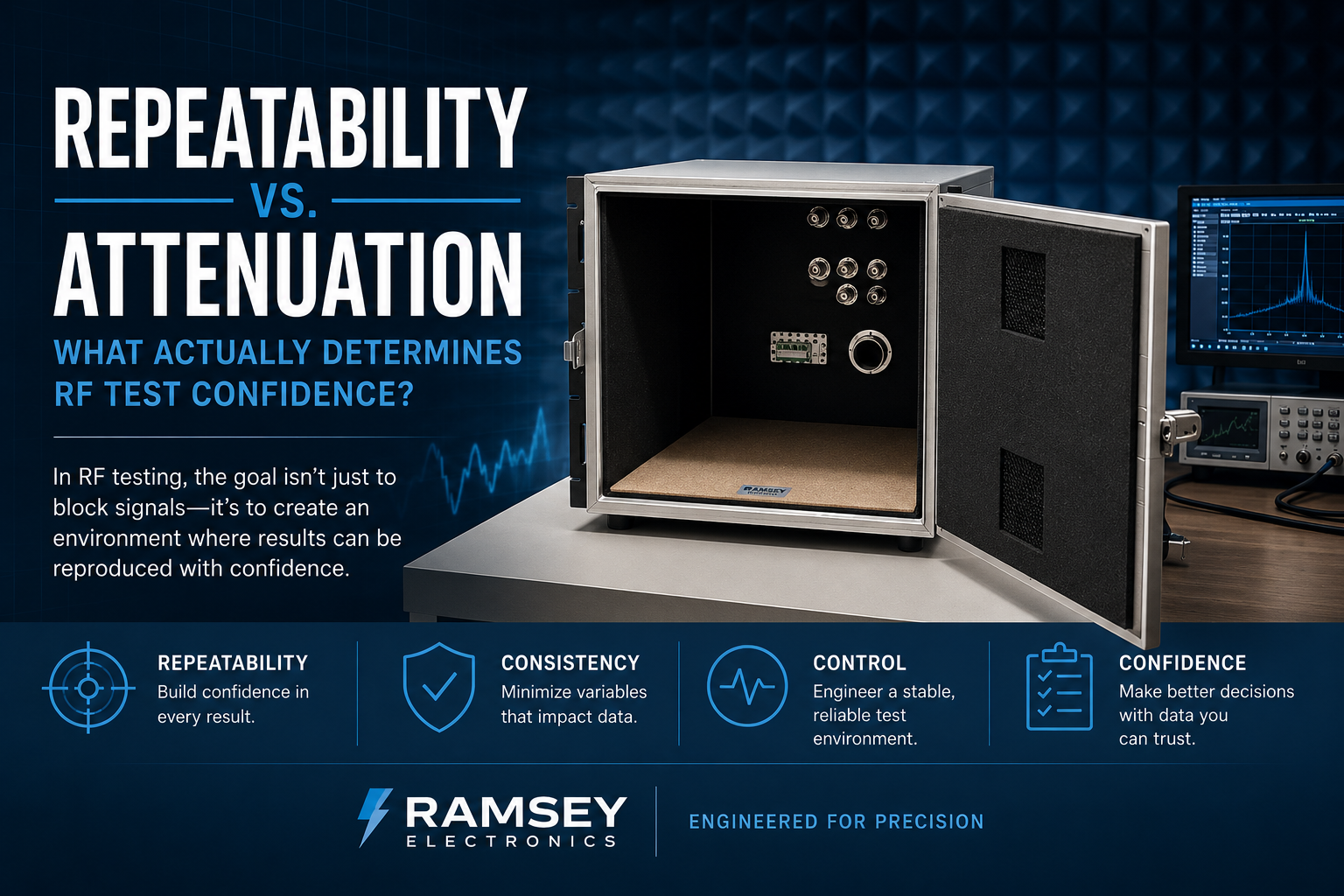
As wireless technologies become more complex and devices operate across broader frequency ranges, the conversation around RF testing is beginning to shift. Engineers are increasingly focused on repeatability, consistency, and confidence in their data rather than a single attenuation specification.
Because in real-world testing, the goal is not simply to block signals. The goal is to create an environment where results can be reproduced with confidence.
The Problem with Single-Number Specifications
Attenuation is an important measurement, but it is only one piece of a much larger picture.
Many published attenuation figures are generated under carefully controlled conditions and often represent performance at specific frequencies or ideal test configurations. While these numbers provide valuable information, they do not necessarily reflect how an enclosure will perform across a broad range of frequencies, interfaces, or operating conditions.
A test enclosure may demonstrate impressive attenuation at one frequency while exhibiting different characteristics at another.
Likewise, two enclosures with similar attenuation ratings may deliver very different real-world results depending on factors such as:
- Interface design
- Construction tolerances
- Gasket performance
- Frequency range
- Environmental conditions
- Long-term mechanical wear
For engineering teams, this creates an important distinction:
Attenuation measures shielding performance.
Repeatability measures testing confidence.
The two are related, but they are not the same thing.
Why Repeatability Matters
Consider a common scenario.
A device under test is evaluated in one laboratory and produces a specific result. The same device is tested again several weeks later, or perhaps at another facility, and the results differ.
Immediately, questions begin to surface:
- Has the device changed?
- Has the software changed?
- Was the test procedure followed correctly?
- Is the environment introducing variables?
When results cannot be reproduced consistently, development cycles slow down. Teams spend valuable time investigating discrepancies rather than moving projects forward.
In industries where validation, certification, or compliance testing is critical, even minor inconsistencies can have significant consequences.
Repeatability is not simply an operational convenience. It is a fundamental requirement for trustworthy engineering data.
Sources of Variability in RF Test Environments
Achieving repeatable results requires controlling far more than external signals.
Several factors can introduce variability into a testing environment, even when attenuation levels appear acceptable.
Interface Performance
One of the most common sources of inconsistency is the interface itself.
Modern testing environments rely on high-speed Ethernet, USB, power feeds, and other communication pathways. Poorly designed or improperly filtered interfaces can introduce leakage paths or affect signal integrity.
In many cases, what appears to be a shielding issue is actually an interface issue.
As data rates continue to increase, interface design has become just as important as enclosure design.
Environmental RF Conditions
No two facilities are exactly alike.
Nearby cellular towers, Wi-Fi infrastructure, radio systems, and building construction can all influence the electromagnetic environment surrounding a test setup.
Without adequate control, these external variables can affect test consistency and make comparisons between environments more difficult.
Construction Quality
At higher frequencies, seemingly small details can have significant consequences.
Factors such as:
- Seam integrity
- Door alignment
- Gasket condition
- Mechanical tolerances
all contribute to overall shielding effectiveness.
Consistency in manufacturing is often a key contributor to consistency in testing.
Frequency Range Considerations
Modern devices rarely operate on a single frequency.
Today’s testing environments must support multiple wireless protocols, broader frequency ranges, and increasingly complex device architectures.
An enclosure optimized for one frequency range may not deliver the same performance across another.
This is one reason why repeatability has become such an important metric for modern RF testing environments.
The Shift Toward Engineering Confidence
As technologies such as 5G, Wi-Fi 6E, IoT, and advanced wireless systems continue to expand, engineers are placing greater emphasis on confidence rather than simply specifications.
The goal is no longer to achieve the highest attenuation number possible.
The goal is to create an environment where results remain:
- Consistent
- Predictable
- Reproducible
- Defensible
Confidence in testing comes from understanding that the environment is not introducing unknown variables into the process.
In many ways, repeatability has become the practical measurement of test quality.
How Ramsey Approaches Repeatability
At Ramsey Electronics, the conversation has never been limited to attenuation alone.
While shielding performance remains essential, the broader objective is creating controlled RF environments that support reliable and repeatable testing outcomes.
This philosophy influences every aspect of enclosure design, including:
Precision Construction
Consistent manufacturing processes help ensure that each enclosure performs as intended across its operational frequency range.
High-Performance Interfaces
Modern testing environments depend on reliable connectivity. Ramsey’s RF-filtered interfaces are engineered to support high-speed communications while maintaining shielding integrity.
Real-World Validation
Testing environments are evaluated based on practical performance, not just theoretical specifications.
Flexible Configurations
With more than 35 standard models and thousands of potential configurations, Ramsey solutions can be tailored to specific testing requirements without sacrificing consistency.
The result is an RF environment designed not only to attenuate signals, but to support confidence in every test performed within it.
Conclusion: Confidence Is the Real Benchmark
Attenuation will always be an important part of RF shielding discussions.
But as wireless technologies become more sophisticated and testing environments grow more complex, engineers are beginning to recognize that attenuation alone does not determine success.
The true measure of a testing environment is confidence.
Can results be reproduced?
Can data be trusted?
Can engineers make decisions without questioning the environment itself?
These are the questions that define modern RF testing.
Because ultimately, the purpose of a shielded test enclosure is not simply to block signals.
It is to provide the confidence needed to move forward with certainty.
For organizations evaluating RF testing environments today, the most important specification may not be attenuation at all.
It may be repeatability.